
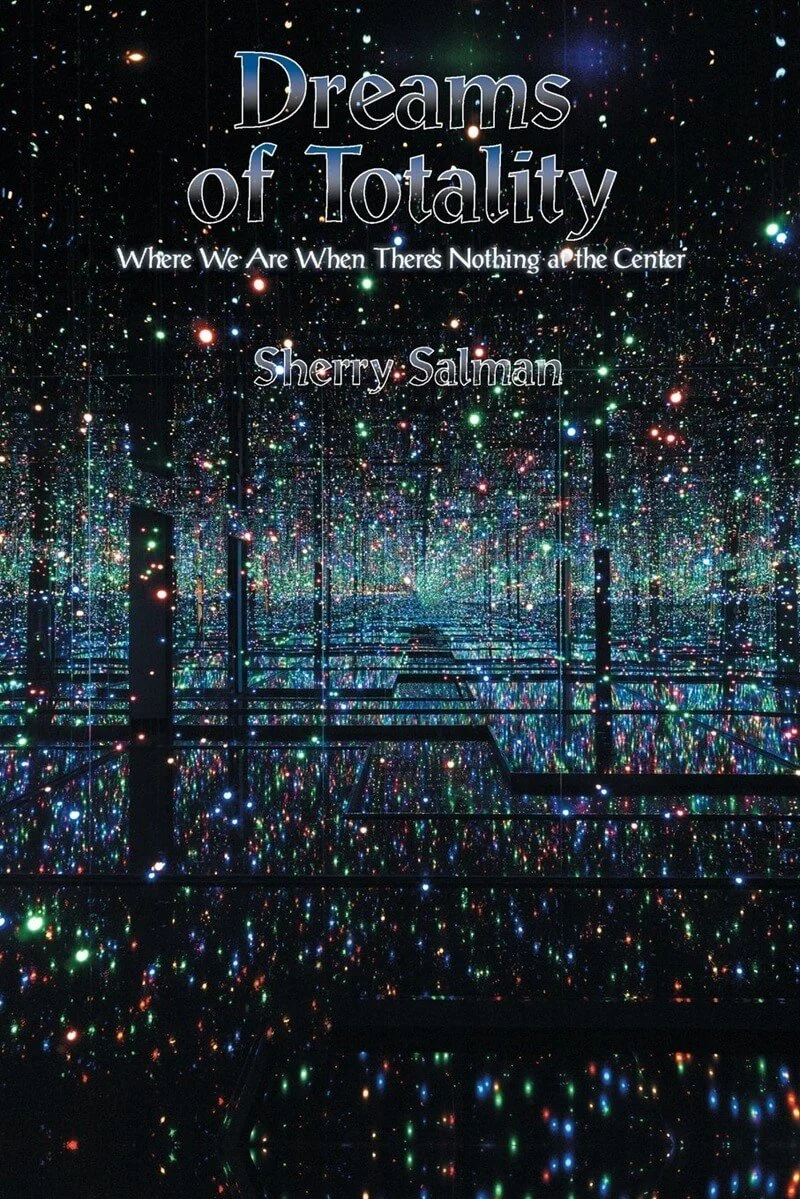
Dreams of Totality
The kingdom of heaven, global climate meltdown and networks of terror, the beloved who completes us, and the virtual cyber village all have something in common. As products of our imagination, symbolic expressions of totality like these orient individual and collective life. Both panacea and poison, our dreams of totality power religious beliefs, sociopolitical programs such as capitalism and globalism, psychology's narratives of wholeness, even our ideas about individual and cultural health.
When dreams of totality go bad, and they often do–becoming totalitarian or fundamentalist–they are more destructive than any plague or natural disaster. Dreams of Totality explores images of wholeness in cultures from ancient civilizations through today. It explains why symbols of totality appear without fail in response to chaos and distress, how they subsequently entomb us, and then eventually deconstruct as disenfranchised elements of psyche and society press for inclusion. Today, unmoored dreams of totality like globalization and the virtual Web community are taking over our collective imagination at the same time we are being exploited by a surfeit of image-industry spin. But as this book explains, we can't go backward into malignant nostalgia for a time when the gods spoke as one, take refuge in fractured fundamentalisms, nor should we succumb to a casual relationship to truth. Rather, preserving the creative function of dreaming of totality while at the same time loosening its often-deadening grip–an Rx for taking the medicine of totality when there's nothing at the center–is crucial as we try to cultivate an ethic of responsibility and integrity toward one another on a global scale.
Praise for Dreams of Totality
“This book is for those of us who struggle to find a footing in the twenty-first century. The ground has transformed into a wobbly web, and to be in Sherry Salman’s bright, wise company is a relief and a refreshment. I emerged from this reading experience less lonely and more awake. The center does not hold? Read this book immediately. It helps.”
— Marie Howe, New York State Poet Laureate, author of What the Living Do, and Pulitzer Prize-winning, New and Selected Poems
"With unerring poise, the integrity of Sherry Salman's prose reflects long experience with the 'poison and panacea' that intimations of totality can be... Salman eases Jungian psychology into the twenty-first century, reminding us that only an evolving consciousness structured by an imagination that is free to release as well as contain, can ever lay claim to being complete."
— John Beebe, author of Integrity in Depth

Excerpts
-
In 2008 people everywhere were saying, “He’s the one”—but they weren’t talking about the messiah of a triumphant second coming or about Neo, the reluctant millennial hero of The Matrix. This wasn’t religion or science fiction—it was politics, and “the one” was a man who would become the forty-fourth president of the United States, Barack Obama. “Obama mania” was spreading through the world, bringing with it both a fresh and an age-old dream of hope and redemption. The old king had died—in the form of former president George W. Bush—and the new king appeared poised to preside over a twenty-first-century Camelot, the global cyber village.
Our imagination works hard to fashion images and stories like this – to create fantasies and dreams of totality in the form of narratives, metaphors, and images of wholeness that serve to give a center and meaning to individual and collective life. We do so especially during times of uncertainty and distress, and the dreams of totality we fashion materialize in the right spot at the right moment— penetrating into the heart of what matters to us most. For as mythology and history have shown, there is a consistent and enduring call and response dynamic in the human imagination, a pattern of lost and found: the disappearance of a dream of totality is always followed either by a search for what will restore unity or the creation of an enlarged vision of what constitutes wholeness – the return of Persephone and spring after the darkness of grief and winter, the next incarnation of the Dalai Lama, the risen and transfigured Christ, societal models and ‘isms’ like capitalism and communism, or fantasies of wholeness like globalization.
The dreams of totality that emerge from within us do so either with a sense of unshakeable even messianic conviction, feeling completely and self-evidently right, or sometimes with a quieter grace. The uncertainty and fragmented quality of contemporary life, for example, calls out in the imagination for some kind of reconstitution – that is the dynamic of dreaming of totality. In answer to that call, there is a strong pull to default to the seeming correctives of a mighty apocalypse, or a new grail of global consciousness with its implicit promise of a global cyber village. We cling for dear life to our laptops and Smartphones, which have attained the status of charged fetishes and umbilical cords – prayer beads and connections to the dream of totality this is the World Wide Web.
Imagination really is more important than knowledge. It’s the game we play and the ground we play it in. We are primed to integrate our experience and reactions into wholes, particularly in response to stress or fragmentation, and the images and paradigms of totality we create are capable of moving feelings and emotions in a way that rational thought is not. These symbolic creations are not irrational but simply nonrational—an aspect of the mythopoetic mind, tied to the body and to our emotions. This tie to our bodies and emotions accounts for the deeply adaptive function of our dreams of totality, as well as for their propensity for fixation and compulsive behavior. Dreaming of totality reinforces a movement toward radical democracy in the psyche and society when it promotes inclusion and creative transgression, but dreams of totality can also harden into reactionary totalitarianism or an apocalyptic mysticism. Right now in America, for example, a distinctive characteristic of democracy’s dream, ‘e pluribus unum’ (out of many, one) is straining at the seams, threatening to break apart into dysfunctional pieces, to close down under the umbrella of homeland security, and to replace the ‘many’ with ‘money.’ In keeping with the dual nature of its ubiquitous symbol, the circle or sphere, our dreams of totality can be inclusive but also exclusionary. They are both womb and tomb, a subversive kiss or a locked down embrace, visions of possibility or the elaborate coffins for the soul and society that prohibit the imagining of new worlds.
Our imagination’s dreams of totality are a great psychological remedy that’s both panacea and poison, a capacity of mind and heart we all share that is intimately responsive to the needs and the ecosystems of time and place. And so, with the stirrings of our contemporary postmodern sensibility and the explosion of communications technology, the previously unthinkable possibility that there might be nothing at the center of either individual or collective life is upon us—and there is no going back. There is no possibility of returning to the stability of “traditional values,” to societies embedded in nature, to theocracies, or to totalitarian systems; soon even unbridled free markets will no longer be an option. Once upon a time those fantasies of wholeness and containment were up to date and expressed the spirit of their times, which is why they can’t be re-created from whole cloth—their time has passed and they lack the objectivity of living experience. Many of them have little to contribute to the pressing questions of our time.
For one thing, our contemporary fantasies of wholeness—the ones through which we live and breathe like globalization and cyberspace—are no longer reliably organized or located anywhere, and they lack centers of emotional gravity. Instead, they seem to shift and change shape, are deferred and referred, appearing and disappearing in ways that feel fragmented and chaotic. As what contained us before no longer does, several things seem to be happening at once. Fanaticism and fundamentalisms of all sorts—religious, political, social—arise in compensation, struggling vigorously to restore order, especially as new dreams like globalization and the virtual world of the Web are pressing forward and taking over our collective imagination. Many people revel in the destruction of old forms in a kind of gleeful or righteous apocalyptic nihilism. Many adopt a casual “whatever” relationship to truth, or are lulled into passivity by the spectacles of disaster celebrated by the media industry, perhaps our contemporary form of the bread and circuses that characterized the Roman Empire before its fall. Luckily, the regressive nature of these nostalgic projects is eventually exposed by their cognitive and emotional primitivity. Or so we hope.
While we still imagine totality in images and events like globalization and the virtual world, we are also aware that our projections of wholeness and the centering function of social systems and self don’t hold together very well anymore. We no longer integrate conflicting tendencies in contemporary life so much as we live them out. It’s a double crunch, for we are now in trouble as things don’t hold together, but also if they do. There’s the satisfying reverberation of reality in this, and the opportunity for something new that a relationship with the freshness of reality always offers. And we also experience frightening feelings of anxiety, arbitrariness, and fantasies of disintegration – as the all-seeing eye of imagination no longer beholds monomythic totalities, but rather, blinking and updating, it skims lightly over the surface of everything, like the virtual map of Google Earth.
Excerpted from Introduction and Chapter 1

-
The indifference and the immediacy of virtual life on the Web is both liberating and undermining. The restraints and boundaries that characterized older dreams of totality seem to no longer apply. Everything seems possible and is accessible. The original and the forgery are equally appealing and hard to discern. As images and emotion enter virtual reportage, art and fact blend into a hybrid form that expresses the essence and uncertainty of postmodern life, as opposed to a canonical corpus into which we used to try and fit our experience. What we buy into (whether belief or brand name) is completely up for grabs, as is the option, “hey, I just don’t buy that.” The human psyche has been released further than ever from certainty, the unthinkable has become thinkable, along with the option not to think or feel at all—and we act, or don’t, accordingly.
We are living in a really open society now, constrained by very little. Fabricators and prevaricators, entrepreneurs and con men, creators and destroyers, the artistic and the artless, the grandiose, the broken, and the genuine articles—all abide side by side offering opportunity and promoting opportunism. A lot of what we used to keep hidden or private is now exposed to the light of day for all to see. It’s always high noon during summer on the Web—even if we log on in the dark. The Web doesn’t care what we do, how we do it, why we do it, or with whom. We however, attribute qualities to the virtual world and to others in cyberspace that aren’t really there. We project our minds and our feelings onto—some would say increasingly into—the virtual world, filling in the actual inconsistencies that abound there with what we imagine, rearranging fragments into wholes, restoring symmetry, fashioning a new dream of totality. In part this is the message of the medium—that it allows us to do this so transparently—and it’s also a massage.
Although we project all sorts of things onto it the Web is completely indifferent to the words and images posted, equally welcoming of wonderful new ideas and child pornography, great works of art and junk, significant inventions, terrorist hubs, racist manifestos, inspiring essays, useful information, manipulative lies, instructions for self-improvement and for making toxic chemical agents. It permits any and all transgressions. It almost seems to be playing a game with us as we play games with it, allowing us to render and control even the most intimate expression of self in relationship to another. YouPorn, for example, an amateur video site, is the most popular pornography site on the Web. But, interestingly, it’s not exactly transgressive either, because it isn’t really hidden or “dirty” anymore.
To transgress creatively you need to feel the press of limits. To move the boundary marker you need to know where it was. We are faced with a special quandary in contemporary life because the Web allows us to move across boundaries and transgress margins by erasing and blending them so easily. Without centers and boundaries, transgression becomes a very confusing affair. The popular pastime of Facebook stalking, for example—lurking obsessively on someone’s Facebook profile, usually someone never spoken to—is, like YouPorn, a transgression that doesn’t really transgress. It’s not taboo; it’s just a little creepy.
With the loss of traditional symbolic centers comes a seeming loss of direct access to meaning—at least to the sort of meaning we are used to. The good news is that the increasing transparency of our contemporary dreams of totality like the world of virtual cyberspace allows their imaginary origin to shine through, making it easier to dismantle our identification with particular dreams and to recognize that where we are when there’s nothing at the center is in the imagination’s endless series of calls, echoes, and responses. Even though complexity has been with us forever, we no longer have the option of waiting hopefully for the gods to speak with one voice again. Imagination has finally delivered its multiple messages and there is no going back, no filtering those out, no center beyond or behind that.
What is at stake though is staying ethical amid the flow and flux of images and identities. What’s new is that a sensibility of meaning doesn’t have to come from a worldview, a belief system, or any dream of totality—be it family, culture, religion, or even our dependence on the natural world. Once upon a time these sufficed and were containing. Part of what we’ve seen is that desperate attempts at resuscitation or relocation are futile, beside the point, even downright dangerous. We are in the process of outgrowing such identifications. Equally problematic though is reacting to this by identifying with nihilism or with “whatever” thinking. This is hard, because it can often seem as if the portal into the creative imagination is now just a revolving door—and even that is closing fast, thanks to the glut of images surrounding us.
If we identify with or get swept away by fragmentation and loss, or get caught in malignant transgressions and simulations, the more ripe we become for takeover by totalitarianism of whatever stripe—corporate capitalism disguised as democracy or globalization, or even the fantasy of a friendly green planet. And while it is strange indeed that we can go shopping in the “meaning mall,” where a plurality of meanings are on display, meanings that we can buy into—or not—including a choice about buying the whole meaning scenario, this situation—confusing, liberating, and deceptive as it may be—is also part of where we are when there’s no one thing at the center. As dreams of totality fall away, our imagination’s provision to dream them is revealed and can come fully into its own. In the same way, we can come to know that meaning is always just there, a part of us as we are a part of it.From Chapter 6, Virtuality and Its Transgressions: the Masking and Unmasking of Imagination, pages 180-184 and From Chapter 7: the Rx pages 192-193